
Alternative Education: Unlocking the Learning Potential of All Students

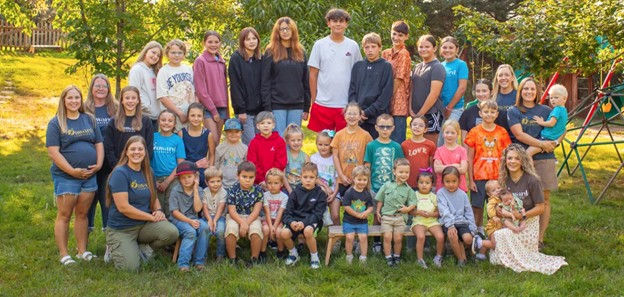
As a proponent of school choice and someone who believes parents are the primary educators of their children, I recently spent a day observing what students are learning at Onward Learning here in Martin, South Dakota. I had heard many positive things about the school, but to become a more informed legislator — and future educator — I wanted to see firsthand what was happening in the classroom and what all the “buzz” was about.

According to its website, the vision of Onward Learning is:
At Onward Learning, we ensure a safe community of interactive learning with a love-based child centered approach. Every child is seen as extraordinary and is supported in finding their own unique strengths and interests through embracing curiosity, creativity, connection, and independence...We meet every child where they’re at and adjust daily to meet the needs of each individual child.
I could not agree more with this vision that educators must meet each child where they are and help them grow. It is up to all of us—parents and grandparents, educators, and all members of our communities—to unlock every child’s God-given potential.
When I read Onward Learning’s vision statement, I immediately thought of Helen Keller, who was born deaf and blind. Her teacher, Anne Sullivan, refused to give up on her. Out of patience, perseverance, and love for her student, Sullivan taught Keller how to read and write. Historical correspondence shows that Sullivan began teaching Keller vocabulary based on the child’s own interests.
If Anne Sullivan could devote the patience and care necessary to teach Helen Keller how to communicate with the world, then surely we owe it to our children to embrace innovative and alternative methods of learning that uplift every student, especially those who face learning challenges.
As I approached the school on Tuesday morning, I immediately sensed a spirit of love, calmness, and joy. Before breakfast, children from Pre-K through eighth grade were playing together on the playground. Their enthusiasm and excitement were unmistakable. The students were full of energy and clearly eager to be at school.
This was not a rigid learning environment. Instead, the playground itself invited exploration, imagination, and creative play. I saw trees that children could climb, playground equipment that helped develop motor skills, and a wooden “Hobbit House” where students could explore their imagination. There was even a hospital-themed play area—complete with its own mock morgue—where students could role-play in a makeshift triage setting. Nearby stood a small basketball court designed for younger students and a zip line with a mounted tire swing that allowed children to soar through a forest-like setting.

Throughout the day, I was struck by the amount of interaction among the students. At first, I wondered how any learning could take place with so much activity and conversation. But to my amazement, the collaborative style of learning was exactly what the students craved, and I could see the excitement on their faces. There were no bathroom passes, enforced quiet periods, or requests for permission to leave a seat. Instead, students were actively engaged in lessons that typically lasted 20 to 30 minutes.
The learning environment reminded me of a modern version of the one-room schoolhouse. Students in Pre-K through kindergarten were located in the basement, separated from the activities on the main level of the home, so they could have their afternoon nap time.
After breakfast, the students gathered to perform the Pledge of Allegiance. One student held the flag while the others placed their right hands over their hearts. As a veteran, it was especially heartwarming to watch the kindergarten students focus their attention on the flag and recite the pledge.
Throughout the morning, I observed a wide range of learning activities. Kindergarten students used a deck of cards to practice adding numbers together. Pre-K students stamped letters with ink blocks to learn the alphabet and practice printing their names. Third- through fifth-grade students worked on writing assignments of their choice using a rubric that challenged them to strengthen their writing by incorporating stronger action verbs and using -ly adverbs in each paragraph.
I watched sixth- through eighth-grade students identify the parts of speech in sentences and work together to solve pre-algebra graphing problems. I also observed small-group instruction where students were learning the Lakota language.
In the afternoon, students studied Earth science concepts such as the geosphere, atmosphere, hydrosphere, and biosphere, using the meanings of Greek root words to help them understand each term. Later, during a “curiosity” class period, students applied their science learning by creating landscape watercolor paintings using watercolor pencils. As they watched an instructional video of an artist demonstrating the technique, they followed along step by step while expressing their own creativity.
I will admit the classrooms felt somewhat crowded inside the home, which serves fewer than forty students. However, the level of engagement and learning more than made up for the limited space. I noticed a small bedroom set up with a desk and iPad where students could receive one-on-one virtual instruction from trained professionals if they needed additional academic support. The room also housed the school’s class pet—a bearded dragon named Leo.
Throughout the day, the smell of a home-cooked meal drifted from the kitchen area, where lunch was being prepared for the students. The warmth and aroma from the kitchen added to the welcoming atmosphere of the school. For lunch, students enjoyed locally grown cut corn, grapes, and freshly made burritos.
Because the school does not participate in the USDA school lunch reimbursement program, it has flexibility in what it chooses to serve. Students could also help themselves to snacks if they became hungry during the day.
One of the most intriguing aspects of the school was the interaction between older and younger students. I saw older students helping younger ones, including pulling a younger child on a sled. During the winter months, staff explained that students often go sledding on the large hill at the local golf course.
I also learned that the school regularly organizes educational field trips. The week before my visit, students traveled to Fire Station 1 in Rapid City to learn about emergency response and the important work performed by firefighters and EMTs.
By the end of the day, I felt grateful to have spent time observing these students and educators. As someone who received a traditional public school education in a structured classroom environment, the experience reinforced for me that learning does not have to follow a single model.
There are many pathways to education, and a one-size-fits-all approach does not serve every student. In my conversations with the teaching staff at Onward Learning, it became clear that simply increasing funding will not solve the challenges facing our K–12 education system. The real challenge is giving teachers the ability to differentiate instruction to meet the diverse learning needs of every student.
Effective education begins with meeting students where they are and encouraging them to take ownership of their learning. It also requires recognizing that learning is not confined to a classroom. Some of the most meaningful learning occurs when students are allowed to explore and engage their auditory, visual, kinesthetic, and tactile senses.
When educators foster curiosity, creativity, and a love of learning, students discover their potential—and education becomes something they pursue, not something imposed upon them.
At the end of the day, students were dismissed as two teachers prepared to shuttle them home in school vans for families within the Martin area whose parents were unable to pick them up. Because there is no collaborative busing agreement with the local school district, this transportation is handled directly by the school.
Before leaving, I thanked Mary Jo Fairhead, the founder of Onward Learning, for her time and for allowing me the opportunity to observe the classroom environment. It was both eye-opening, inspirational, and refreshing to witness firsthand the innovative learning environment that so many in our community have been talking about.
If elected to the South Dakota legislature, I will reflect on my experience at Onward Learning and advocate for policies that support school choice and protect parental rights in their children’s educational journey.


Comments