
Time to Rein in the Government Giveaways

Updated: Jan 28
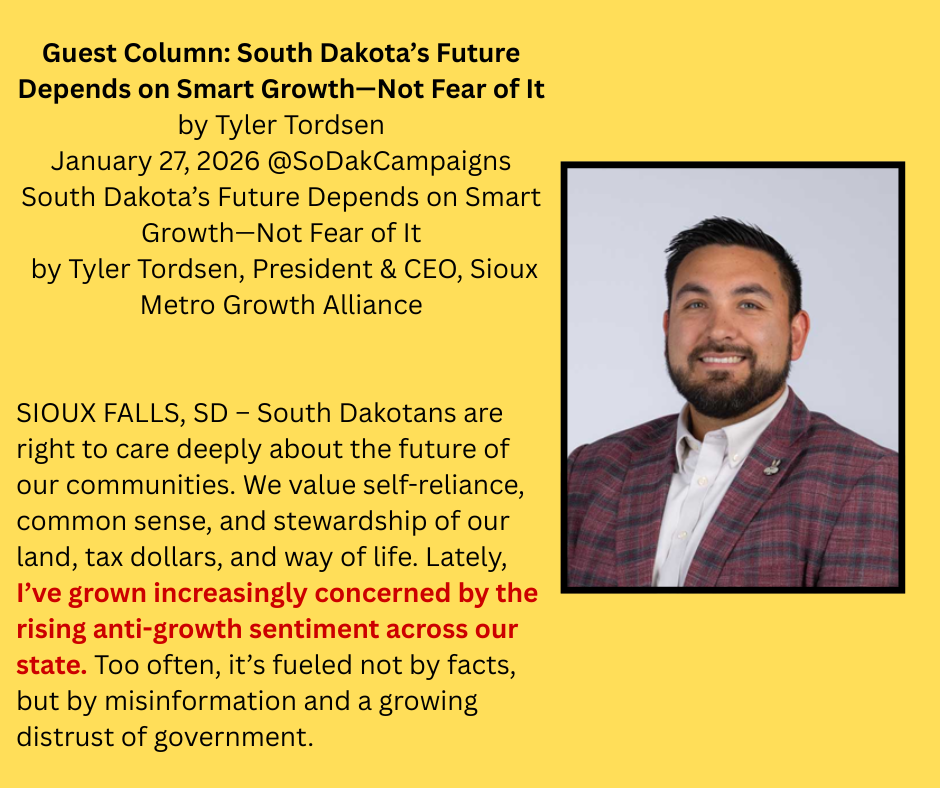
Yesterday, I came across this article by Tyler Tordsen, who announced his candidacy for South Dakota's District 14 House seat. You can read the full text of the article here: https://dakotawarcollege.com/guest-column-south-dakotas-future-depends-on-smart-growth-not-fear-of-it-by-tyler-tordsen/.
Tordsen is a former State House Representative and now serves as the President and CEO of the Sioux Metro Growth Alliance (SMGA), South Dakota's largest regional non-profit economic development organization. Tordsen oversees the day-to-day operations of SMGA's staff and mission as it serves its seventeen member municipalities, five counties, and multiple chambers of commerce, economic development offices, and more in the greater Sioux Falls region.
Below are my comments on what Tyler shared in his article (highlighted in yellow) titled South Dakota's Future Depends on Smart Growth - Not Fear of It.
Lately, I’ve grown increasingly concerned by the rising anti-growth sentiment across our state. Too often, it’s fueled not by facts, but by misinformation and a growing distrust of government.
Kathol: What is happening in Minnesota should cause everyone to pause at the level of waste, fraud, and abuse in government with little to no oversight. The billions of federal and state taxpayer dollars being sent out the door en masse are incomprehensible. Everybody should be concerned about what government officials are doing behind closed doors, where government agents pick winners and losers in receiving economic development loans and grants for teams of businesses that have connections to the purse strings of the Governor's Office of Economic Development. My question is, where in the Constitution does it give any branch of government the role of economic development?
At the same time, we’re increasingly resistant to new housing, infrastructure, and economic development projects that could expand the tax base and help ease that burden over time. We can’t continue to demand tax relief while blocking the very growth that makes it possible.
Kathol: The grassroots movement growing in South Dakota is not opposed to development; rather, it seeks sustainable development that benefits the greater good of society, not the corporate elite or the "haves" who manipulate and bully everyday South Dakotans, a David and Goliath if you will. The Goliaths of the world come into our state and will do whatever it takes, using their high-dollar attorneys, to get their way. Not only is this un-American, but this is not a shared value of everyday South Dakotans who interact with their neighbors on a daily basis. In regard to the development of expanding the tax base, how often have you seen the tax burden go down over time? I have yet to see property taxes go down as a result of expanding the tax base. If anything, taxes go up because the county or municipality now has additional infrastructure needs to operate and maintain, as a result of growth, and property values increase due to high demand. Real tax relief comes when landowners are no longer tenants or enslaved to the government under the guise of property taxes.
One of the most common narratives I hear is that economic development in South Dakota only benefits large, out-of-state corporations. It’s nothing more than “corporate welfare,” handouts, or giveaways for million-dollar projects, while locals are left behind. I understand why that perception exists. But I can also tell you, from direct experience, that it doesn’t reflect reality.
Kathol: Does Tordsen live in a bubble? I am not seeing that growth in rural South Dakota, especially here in Martin and in other reservation communities across South Dakota. Our Main Street had much more economic development activity 75 years ago than it does today. Small-town communities are being decimated by the draw of job opportunities and big attractions in our urban centers because the government sides with big tech and corporations, leaving smaller municipalities without the resources, manpower, or expertise to take advantage of what is available. Does he realize the challenges that rural communities face, such as finding reliable contractors, health care professionals, attorneys, educators, appraisers, engineers, electricians, plumbers, and accountants, to name just a few? Let alone, let's not forget that the cost of doing business in a rural area is higher due to its remoteness; all one has to do is walk into the local grocery or hardware store to see this hidden truth.
Whether it’s a small-town infrastructure need, a local business expansion, or a housing project that helps a community remain viable, our role is to connect people to tools that might already exist and ensure they have a fair shot, regardless of their ZIP code or size of their balance sheet.
Kathol: Talk to any farmer or rancher about a balance sheet and whether they get a "fair shot" from that lending officer who will continue to secure a loan for them when markets are unpredictable year after year due to conditions beyond their control. My parents experienced foreclosure in the 1980s on $70k+ loan. The lender had no problem shutting down my parents' farming operation. Lenders are in the business to make money. They are going to invest in businesses that offer the highest return on their investment and are safe bets. It is no different when I have a small job to be done. I can't find a contractor to do the work because it's chump change for the contractor, and I am willing to pay good money. Hence, they only want the big jobs. This is no different in the lending world, where big corporations are favored over the small guy because lenders do not want to take on the high risk.
There are no freebies. There are no giveaways. Every grant, loan, or incentive comes with accountability, local investment, and long-term expectations. When done right, economic development is not about picking winners and losers; it’s about leveling the playing field and giving communities and their people the same opportunity to succeed here.
Kathol: Tordsen needs to go visit Sydney, Nebraska, and learn what happened to their community. (Read more here: https://nebraskapublicmedia.org/en/news/news-articles/how-sidney-is-building-back-better-after-cabelas-headquarters-left-town/)
The community rolled out the red carpet for Cabelas with all sorts of tax incentives, only to be left hanging dry after Bass Pro bought out Cabela's in 2017. Sydney was home to the company headquarters, a nearby distribution center, and the first of several massive retail stores nationwide, creating 2,000 jobs for the town of 6,000 people, only to have it all disappear when the corporation got bought out.
Corporations and venture capitalists are like vultures; they have no allegiance to small-town communities. If the economic environment is more favorable, labor is cheaper, or tax incentives (giveaways) are better elsewhere, they will move. If one recalls, during the Covid-19 pandemic, all the airlines were bailed out by the taxpayer, and now look where they are? Nickel-and-diming the consumer on everything from upcharges for selecting your seat in advance to onboard priority seating, baggage fees, increased food and beverage charges for a cup filled with ice, and the like. It's no longer about the customer. Hence, why should the government be in the business of picking winners and losers? It is not about leveling the playing field, but whoever has the most resources and paid lobbyists wins. We saw that play out firsthand: Rapid City voters overwhelmingly rejected the $125 million Libertyland USA Tax Increment Financing (TIF) in a special election held on January 20, 2026. See: https://www.keloland.com/news/local-news/fallout-following-destination-district-tif-rejected-vote/.
By the way, proponents of the TIF outspent the opponents by 40:1. This is what Tordsen calls "leveling the playing field." Tordsen's "leveling the playing field" is a smokescreen. All one has to do is perform a Google search and find out who the corporate partners are supporting the Sioux Metro Growth Alliance non-profit organization. You can see for yourself who props up this organization here: https://siouxmetro.com/partners/. Below is a snapshot of one of their deep-pocket corporate partners, NextEra Energy.

When a local business expands with the help of a revolving loan fund, workforce program, or infrastructure investment, we should be celebrating that success just as loudly as we do a $100-million announcement. Don’t get me wrong, those big projects matter too.
Kathol: We should be celebrating a $100 million announcement. Really? What about the little guy, such as the small business owner on Main Street, the ag producer, the day care provider, the landlord with a basement apartment for rent? Do these small venture capitalists get celebrated for expanding their businesses with revolving loan funds, workforce programs, or infrastructure investments? The last time I checked, I had to pay out of my own pocket for a new sewer service line when it needed to be replaced to serve my basement apartment. There was no government bailout for my small business venture. More to the point, there was no bailout (no pun intended) when the local municipality's sewer main backed up and flooded my basement apartment, causing over $50k in damage to private property and resulting in lost revenue to my small business. To add insult to injury, the city's sewer backed up not once but twice, even after I insisted that the city camera and inspect the integrity of the sewer main pipe, but that fell on deaf ears, leaving me with a mess to clean up again six months later.
My point is that economic development is not the enemy — pushing growth with poor communication or projects with lack of proper consultation is.
Kathol: I couldn't agree more. Pushing growth with poor communication or developing projects without proper consultation is the enemy. Generally speaking, South Dakotans are a hardy stock, friendly and trustworthy with their neighbors, always willing to give a helping hand when necessary. For over forty years, my father had a gentleman's handshake with the landlord of "our" farm. There was nothing officially written down in writing. A man's word meant something back in the day and is a value that is held dearly by many South Dakotans. When developers and corporations aren't transparent about who they represent or their actual intentions, that is where all faith and trust are lost in a project's development. When big developers come into our state and mislead or deceive the general public, treating us as backward, ill-informed, or as wanting to take advantage of our lax zoning and regulations, it is the ultimate betrayal, and you lose all credibility and respect.
...there are those who continue to sow distrust by reducing economic development to catchy buzzwords and false narratives with rhetoric not rooted in sincere concern for taxpayers or communities, but in political gain.
Kathol: Tordsen has announced he is running for South Dakota's District 14 State House seat in 2026. I wonder what his motivation could be. On his campaign website, he supports a vibrant economy by writing, "Supporting business and the employees that make it all happen will keep our economy vibrant." (See: https://tylertordsen.com/issues/.) The question is: Which business does he plan to support and align himself with if he is elected? The non-profit that he oversees has partnered with big corporations. I don't see any LLCs of ranchers or farmers on the SMGA Corporate Partnership list. Time will tell who is supporting his campaign when the Pre-Primary Campaign Finance Reports are due at the South Dakota Office of the Secretary of State.
We’ve earned the right to be selective in supporting the right projects that are mutually beneficial for all.
Kathol: I couldn't agree more with his statement. The question I have is the use of the word "we" in his sentence. Does the word "we" include all South Dakotans or a handful of South Dakotans with deep pockets who determine what is mutually beneficial for all? As I stated above, the Libertyland USA TIF proponents outspent their opponents 40:1, yet the opponents came out on top because, contrary to popular belief, elections cannot be bought. The same holds true with the No on Referred Law 21 campaign, which was overwhelmingly supported by every county in South Dakota, except one. Summit Carbon Solutions tried to pitch this project as a benefit for all, but in reality, it was smoke and mirrors that would only benefit their shareholders, not everyday South Dakotans.
If we get this right, we improve our chances of being able to lower or stabilize our taxes.
Kathol: Getting it "right" does not necessarily improve our chances of lowering or stabilizing our taxes. At the end of the day, it's not the government's role to perform economic development activities. The government has a fiduciary duty to provide basic services to its citizens, but economic development is not one of them. That is where free-market enterprise comes into play. Stabilizing or lowering our taxes is not going to happen with increased economic growth. Yes, economic development activities provide additional tax revenue to states and municipalities, but governments should not depend on them as a consistent source of revenue, since businesses come and go all the time. A more appropriate response to stabilizing our taxes would be to look at the government's balance sheet and see where cuts can be made, since it is clear after watching what is happening in Minnesota that the government cannot be trusted with managing the taxpayers' money effectively even if there is economic revenue being brought in, and it is a clear indication that there is plenty to cut based on the amount of waste, fraud, and abuse that is presently being reported. South Dakota is not immune to what is occurring in Minnesota. However, when you have agents of government who are not transparent with taxpayer funds, it becomes obvious to the average citizen that the government has plenty of pork that can be trimmed from its budget.
By working more closely with our neighbors, communicating honestly, and choosing to seek progress over paralysis
Kathol: The rising "anti-growth sentiment" you espouse is not against economic development. The grassroots effort sweeping across South Dakota seeks to be consulted on projects that are transparent and open to the public for discussion. We desire sustainable economic growth that benefits our local communities in the long term, that respects private property and local control. When we say "no thank you," developers ought to respect the will of the people and not use eminent domain for private gain to circumvent the planning process. After all, the state motto of South Dakota is "Under God, the people rule," not the corporate elite, the paid lobbyists, and special interest groups such as those that have partnered with SMGA. Your responsibility as a legislator is to your constituents, not the paid lobbyists who want something in return for your vote, which is the paralysis that you speak of in your column. You see, South Dakota has been controlled for too long by the corporate elite, paid lobbyists, and special interest groups, and the everyday South Dakotan has had to take a back seat. Not anymore. That is why the grassroots effort continues to respond accordingly. The role of government is not to pick winners and losers, but to allow free-market enterprise to settle the scorecard.
In closing, self-reliance is a defining part of South Dakota’s cultural heritage. As the old adage reminds us, if you give a man a fish, he eats for a day; if you teach a man to fish, he eats for a lifetime. As a Republican, I firmly believe in a small, limited government, with decisions made as close to the people as possible. Government exists to provide essential services and protections—not to foster dependency or to pick winners and losers through so-called economic development schemes driven by a pay-to-play politicking. I welcome and look forward to continuing this debate if, God willing, I am elected to serve as the state senator representing District 27 (Bennett, Jackson, Oglala Lakota, and East Pennington Counties) in the near future. God bless.


Comments